Introduction to Mars Planet 3D Printable Model
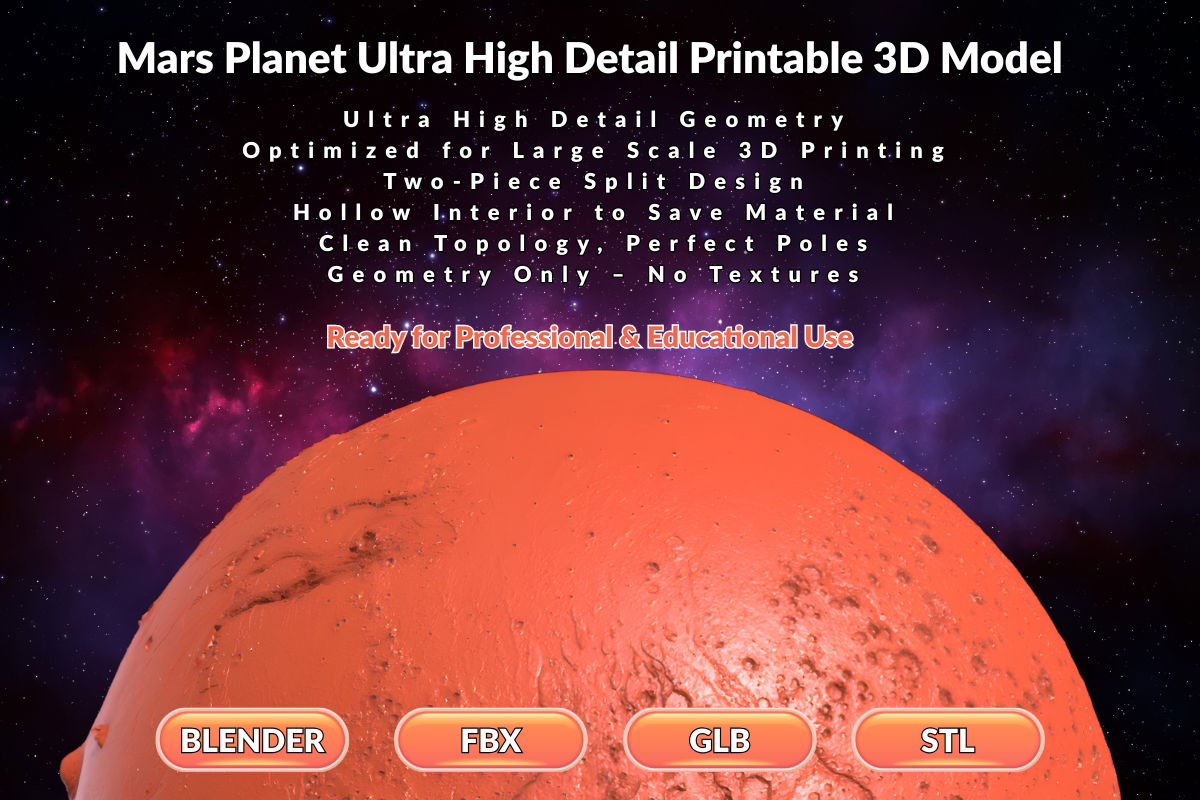
The Mars Planet 3D model is an ultra high-detail printable model designed for professional, educational, and display use. With 3.1 million triangles and 1.6 million vertices, this model captures the intricate surface details of the Red Planet, making it perfect for large-scale 3D printing projects.
Why Choose This Mars Planet Model?
This high-resolution Mars Planet 3D model offers several advantages for 3D printing enthusiasts and professionals:
- Ultra High Detail: 3.1M triangles and 1.6M vertices ensure realistic surface detail
- Two-Piece Design: Split design makes printing and assembly easier for larger scales
- Hollow Interior: Optimized to save material while maintaining structural strength
- Polar Optimization: Special care taken to preserve surface quality at the poles
- Professional Quality: Ideal for educational displays, museums, and commercial projects
Technical Specifications
The Mars Planet model features impressive technical details:
- Triangles: 3.1 million for ultra-high detail
- Vertices: 1.6 million for smooth surface geometry
- Design: Two perfectly insertable parts
- Interior: Hollow design to optimize material usage
- Topology: Optimized at polar areas for consistent detail
- Geometry Only: No textures or materials included (geometry-focused model)
Available Formats
The Mars Planet model is available in multiple formats to suit different workflows:
- BLENDER: Native format for Blender users
- FBX: Universal format compatible with most 3D software
- STL: Standard format for 3D printing slicers
- GLB: Optimized format for web and real-time applications
Best Practices for Large-Scale Printing
Scale Considerations
For best results, print the Mars Planet model at a large scale:
- Recommended minimum scale: 15-20cm diameter
- Large-scale prints (30cm+) showcase fine surface details best
- Smaller prints may lose detail due to printer resolution limits
- Consider your printer’s build volume when planning scale
Two-Piece Assembly
The model is designed in two perfectly insertable parts:
- Print each hemisphere separately
- Ensure proper orientation to minimize support material
- Use alignment features for accurate assembly
- Consider using adhesive or mechanical fasteners for permanent assembly
Material Optimization
The hollow interior design helps optimize material usage:
- Reduces material consumption by 40-60% compared to solid models
- Maintains structural integrity for large prints
- Reduces printing time significantly
- Allows for internal support structures if needed
3D Printing Workflow
Preparing the Model
Before printing, prepare the Mars Planet model:
- Import the STL or GLB file into your slicer software
- Scale the model to your desired size
- Check for any geometry issues using mesh repair tools
- Verify wall thickness is appropriate for your printer
Slicer Settings
Recommended slicer settings for best results:
- Layer Height: 0.1-0.2mm for fine detail
- Wall Thickness: 2-3mm for structural strength
- Infill: 10-15% (hollow interior reduces need for high infill)
- Support: Minimal supports needed due to two-piece design
- Print Speed: Moderate speed (40-60mm/s) for quality
- Remove support material carefully
- Sand the seam where two halves meet
- Apply primer for painting if desired
- Consider adding a base or stand for display
- Planetary science education
- Astronomy exhibits
- Space exploration displays
- Interactive learning tools
- Space agency presentations
- Planetary research visualization
- Architectural and design projects
- Marketing and promotional materials
- Blender: Direct import of BLENDER format
- Cura: STL format for slicing
- PrusaSlicer: STL format compatible
- Maya/3ds Max: FBX format import
- Web Applications: GLB format for real-time viewing
- Print at large scale to showcase detail
- Use high-quality filament for best surface finish
- Consider multi-color printing for enhanced realism
- Test print a small section first to verify settings
- Use proper bed adhesion techniques for large prints
Post-Processing
After printing, enhance your Mars Planet model:
Use Cases
Educational Displays
Perfect for schools, museums, and educational institutions:
Professional Presentations
Ideal for commercial and professional use:
Software Compatibility
The Mars Planet model works with various 3D software:
Tips for Success
Getting Started
Ready to print your own Mars Planet model? Visit our Mars Planet 3D Model page to view the live Sketchfab preview and download the model in your preferred format.
You can also purchase the model directly on 3D Ocean or browse our complete collection of 3D models.
Conclusion
The Mars Planet ultra high-detail printable 3D model provides everything you need for professional, educational, and display projects. With its two-piece design, hollow interior optimization, and exceptional detail, this model is perfect for large-scale 3D printing and educational displays.