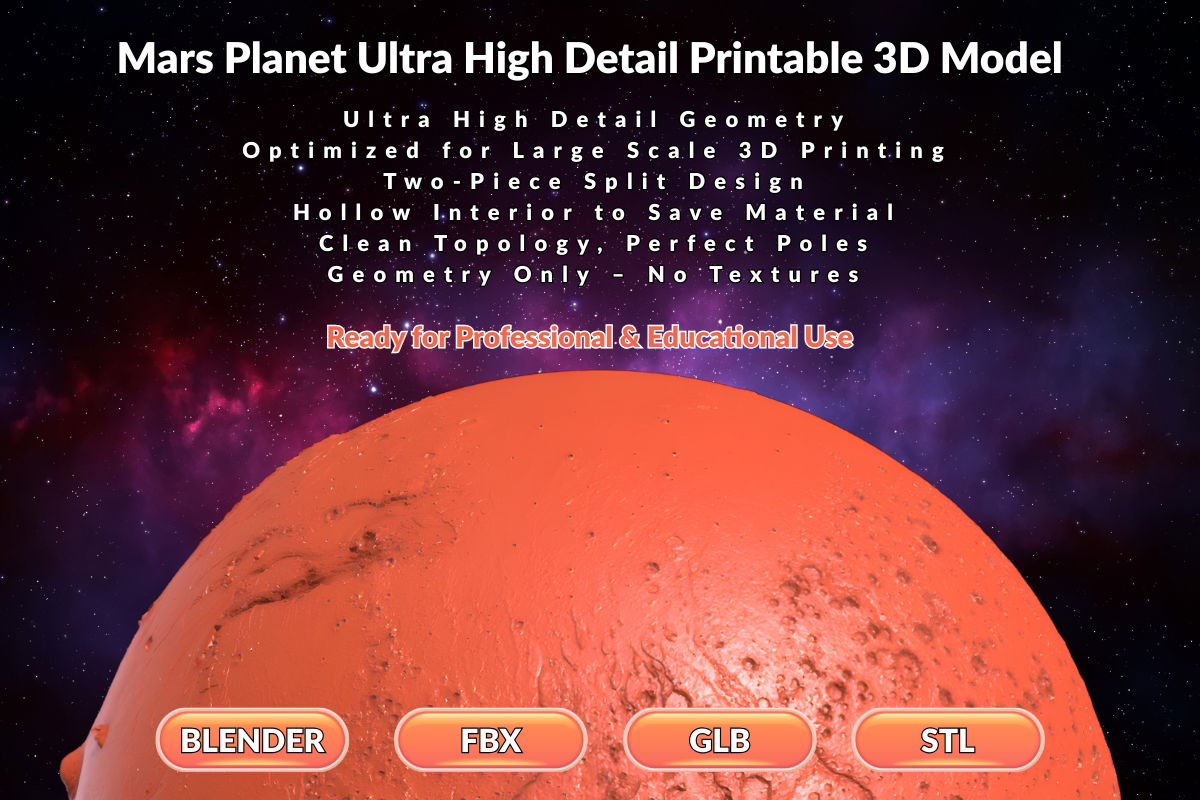
Understanding Ultra High-Detail 3D Printable Models
Ultra high-detail 3D printable models, such as the Mars Planet model with 3.1 million triangles, require specific techniques and considerations to achieve optimal printing results. This guide covers best practices for working with high-resolution planetary and geometric models.
Model Preparation
File Format Selection
Choose the right format for your workflow:
- STL: Best for direct 3D printing, widely supported by slicers
- GLB: Optimized format, good for web preview and some slicers
- FBX: Useful if you need to modify the model before printing
- BLENDER: Best for Blender users who want to customize before export
Mesh Analysis
Before printing, analyze your model:
- Check for non-manifold edges or holes
- Verify wall thickness meets your printer’s minimum requirements
- Ensure the model is watertight (closed mesh)
- Use mesh repair tools if needed (Netfabb, Meshmixer, or Blender)
Slicing Strategies for High-Detail Models
Layer Height Optimization
For ultra high-detail models like Mars Planet:
- Fine Detail: 0.1mm layer height for maximum detail capture
- Balanced: 0.15mm for good detail with reasonable print time
- Large Scale: 0.2mm acceptable for prints over 30cm
- Avoid layer heights above 0.2mm to preserve surface detail
Wall Thickness and Infill
Optimize material usage while maintaining strength:
- Wall Thickness: 2-3mm for structural integrity
- Infill: 10-15% sufficient for hollow models
- Top/Bottom Layers: 4-6 layers for smooth surfaces
- Use gyroid or cubic infill for better internal structure
Support Material Strategy
For two-piece models like Mars Planet:
- Print each hemisphere with minimal supports
- Use tree supports for complex overhangs
- Orient parts to minimize support needs
- Consider printing with the equator as the base
Material Selection
Filament Types
Choose the right material for your project:
- PLA: Easy to print, good detail, suitable for displays
- PETG: More durable, good for educational models
- ABS: Strong but requires heated bed and enclosure
- Resin (SLA): Maximum detail but smaller build volumes
Color Considerations
For planetary models:
- Use red/orange filaments for Mars
- Consider multi-color printing for realism
- Post-processing painting can enhance detail
- Primer helps paint adhere to printed surfaces
Two-Piece Model Assembly
Printing Strategy
For models split into two parts:
- Print both hemispheres separately
- Ensure consistent scale for both parts
- Use same slicer settings for uniformity
- Allow adequate cooling time before assembly
Assembly Techniques
Join the two halves effectively:
- Friction Fit: Use alignment features in the model
- Adhesive: CA glue or epoxy for permanent bonds
- Mechanical: Screws or pins for removable assembly
- Sand the seam for invisible joins
- Level the bed meticulously
- Ensure adequate bed adhesion (PEI, glass, or buildtak)
- Use brim or raft for large base areas
- Monitor first layers closely
- Use OctoPrint or similar for remote monitoring
- Check periodically for layer shifts or warping
- Keep ambient temperature stable
- Have backup filament ready
- Sanding: Start with 220 grit, progress to 400+
- Filling: Use filler primer for layer lines
- Priming: Apply primer before painting
- Painting: Use acrylic paints for color accuracy
- Dry brushing highlights raised features
- Washes emphasize recessed details
- Weathering adds realism to planetary models
- Clear coat protects finished models
- 40-60% material savings
- Faster printing times
- Reduced weight for large prints
- Lower risk of warping
- Ensure adequate wall thickness
- Use strategic infill patterns
- Add internal supports if needed
- Consider drainage holes for resin prints
- Reduce layer height to 0.1mm
- Slow down print speed
- Check nozzle condition (replace if worn)
- Increase model scale
- Check scale consistency between parts
- Account for material shrinkage
- Sand mating surfaces for better fit
- Use heat to adjust fit if using PLA
- Use dual-extrusion for color variations
- Print base and surface in different materials
- Consider soluble supports for complex geometries
- Small (10-15cm): Quick prints, good for testing
- Medium (20-30cm): Balanced detail and time
- Large (40cm+): Maximum detail showcase
Large-Scale Printing Tips
Printer Setup
Prepare your printer for large prints:
Print Monitoring
For long print jobs:
Post-Processing Techniques
Surface Finishing
Enhance your printed Mars Planet model:
Detail Enhancement
Bring out surface details:
Hollow Model Optimization
Benefits of Hollow Design
The Mars Planet model’s hollow interior offers:
Internal Structure
Maintain strength with hollow models:
Troubleshooting Common Issues
Detail Loss
If surface details are lost:
Assembly Problems
If parts don’t fit:
Advanced Techniques
Multi-Material Printing
For enhanced realism:
Scale Variations
Experiment with different scales:
Resources and Support
Get started with the Mars Planet ultra high-detail printable model by visiting our product page. View the live Sketchfab preview and download in your preferred format.
You can purchase the model directly on 3D Ocean or explore our complete 3D Models collection.
Conclusion
Working with ultra high-detail 3D printable models like the Mars Planet requires attention to slicing settings, material selection, and post-processing. By following these best practices, you can achieve stunning results that showcase the intricate details of planetary models and other high-resolution 3D prints.